
Spices: Vanilla
Vanilla
An Orchid Among the Spices
Most people would associate orchids with tropical forests rather than spice racks. Yet vanilla belongs exactly to this plant family, more specifically to the genus Vanilla. Like all orchids, it produces a capsule containing countless tiny seeds after successful pollination. In vanilla, however, this capsule develops into a remarkably long fruit that acquires its characteristic aroma through a complex post-harvest curing process.
A Climbing Plant of the Tropical Forest
The vanilla plant is an evergreen climbing orchid. It produces aerial roots that serve both for anchorage and water uptake. Its natural range lies in the warm, humid lowland forests of Mesoamerica, particularly in what is now southeastern Mexico and parts of Central America. There it grows in partially shaded forest habitats with high humidity and relatively stable temperatures.
“But doesn’t vanilla come from Madagascar?” → No. Madagascar is simply the major center of its commercial cultivation.
A Flower with Specialized Pollination
Vanilla flowers remain open for only a few hours, or at most a single day. In their native range, they are primarily pollinated by stingless bees (Meliponini), which are able to navigate the flower’s specialized structure. Outside this ecological system, the necessary pollinators are absent, making hand pollination essential for commercial production.
The “Pod” That Is Actually a Capsule
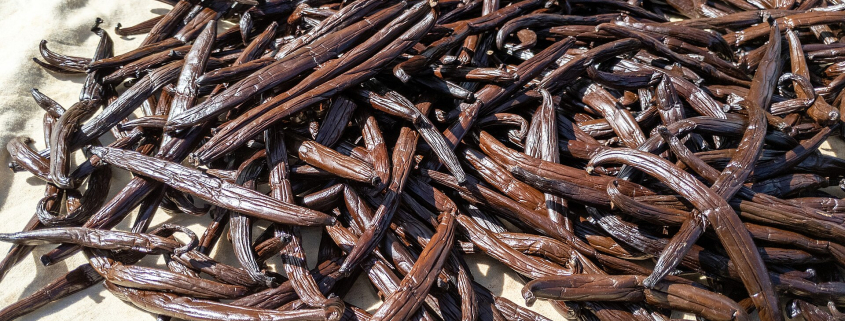
Botanically, the vanilla fruit is a capsule. Following successful pollination, it develops over approximately 6–9 months. The fruit is harvested while still unripe, as the full aroma develops only during the post-harvest curing process. The seeds are embedded in a sticky matrix.
Aroma Formation from Precursors
Fresh vanilla contains very little free aroma. Instead, it is rich in precursor compounds such as glucovanillin, which are enzymatically converted after harvest into vanillin and numerous other aromatic substances. Different vanilla species also vary considerably in their chemical composition. Vanilla tahitensis is characterized by more floral and anise-like notes and a lower vanillin concentration, whereas Vanilla pompona possesses a heavier, more balsamic aroma profile. These chemical differences determine their respective uses in gastronomy and perfumery.
From Fruit to Spice
The curing process consists of several distinct stages: killing the fruit tissue through heat treatment, an enzymatic “sweating” phase, controlled drying, and subsequent maturation. These steps regulate oxygen availability, moisture, and temperature in a way that promotes the efficient conversion of aroma precursors into the characteristic flavor compounds of vanilla.
Is It Really Vanilla?
Vanilla is among the most labor-intensive cultivated crops in the world. Each flower must be pollinated individually, and each fruit harvested by hand. Limited natural pollination and the demanding curing process contribute to substantial price fluctuations. As a result, a large proportion of vanilla flavoring used worldwide is produced synthetically.


 Public Domain