
 Public Domain
Spices: Saffron
Saffron
Valuable Floral Parts
In autumn, when many plants are already retreating, the saffron crocus (Crocus sativus) opens its delicate violet flowers. Unassuming at first glance — yet they contain one of the most valuable products in the plant world.
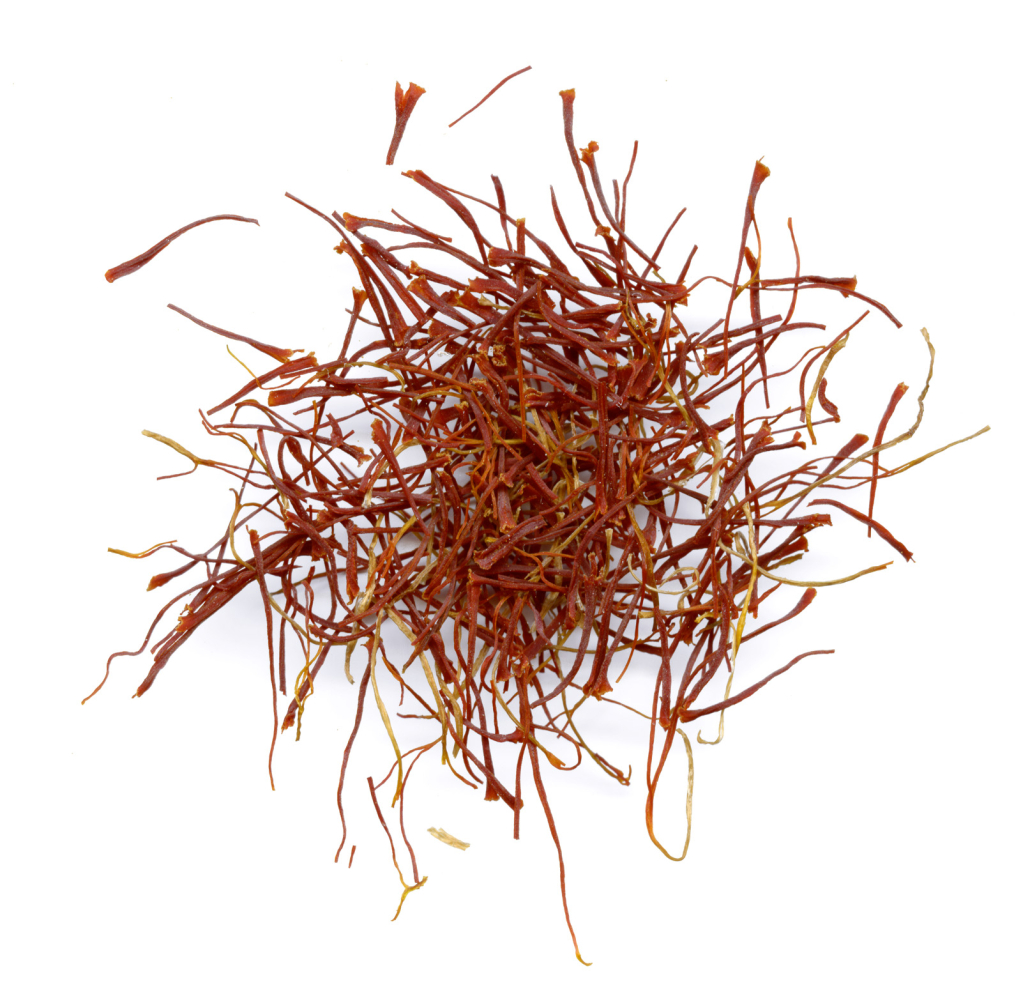
The flower follows the classic structure of the iris family: six petals, and hidden beneath them the three bright red, thread-like stigmas. These sit at the end of the style and are part of the female reproductive organ. Botanically, their role is to receive pollen. For us humans, however, these carpels serve a different purpose: they are used as a spice.
Cultivation and Harvest
Each flower yields exactly three stigmas. To produce one kilogram of saffron, around 150,000 to 200,000 flowers must be picked — each one by hand. Even experienced harvesters manage only about 60–80 grams per day. It is therefore no surprise that saffron can reach prices of up to €30,000 per kilogram — a spice sometimes compared to gold. Cultivation is concentrated in regions with dry summers and mild winters, such as Iran, India, and the Mediterranean. However, there are also smaller cultivation areas with a long tradition in Austria and Germany.
A Global Clone
The saffron crocus is triploid and sterile. This means it does not produce viable seeds and can only reproduce vegetatively, via daughter corms. Corms? Indeed. Although crocuses are often considered bulb plants, their underground storage organs are actually corms.
Research: The Origin of the Saffron Crocus
For a long time, the exact origin of this plant remained unclear. It was not until 2019 that biologists at the Technical University of Dresden solved this botanical puzzle.
Their research showed that the saffron crocus (Crocus sativus) originated from the wild species Crocus cartwrightianus. More precisely, it arose through the merging of the genomes of two slightly different individuals—so-called cytotypes—within this species. This also explains why the saffron crocus is triploid
and sterile.
Their research showed that the saffron crocus (Crocus sativus) originated from the wild species Crocus cartwrightianus. More precisely, it arose through the merging of the genomes of two slightly different individuals—so-called cytotypes—within this species. This also explains why the saffron crocus is triploid
and sterile.
The results were published in the journal New Phytologist (Schmidt et al., [2019](https://doi.org/10.1111/nph.15715)).
An earlier study also concluded that the origin of saffron was most likely a unique event. This is supported by the fact that, worldwide today, there is virtually no genetic and only very little phenotypic diversity within the species (Fluch et al., [2010](https://ishs.org/ishs-article/850_4/)).
In the Kitchen
As a spice, saffron reveals its most well-known effect. Just a few threads are enough to give dishes such as risotto, paella, chimichurri de azafrán, simple rice, as well as desserts or coffee, an intense golden-yellow color and a distinctive aroma. The threads can be used as a powder or soaked in warm water; this infusion is then added to the dish after cooking to preserve the delicate essential oils as much as possible.


 Public Domain