
Spices: Black Pepper

Black Pepper

A Climbing Plant from India

word “pepper” can refer to both the plant and its spice. Botanically, true pepper is Piper nigrum, a long-lived, woody climbing plant native to the Malabar Coast of India. Today, the main growing regions are Vietnam, Indonesia, India, and Brazil. The plant has large, leathery leaves and can grow up to 10 metres tall, but in cultivation it is usually kept at 3–4 metres.


From Flowers to Peppercorns

Peppercorns are the processed fruits of the plant. Around 50 to 150 small fruits develop from the tiny flowers on hanging flower spikes about 10 centimetres long. A pepper plant can be harvested twice a year and produces good yields for up to 30 years.


Four Colours

Green, black, white, and red pepper all come from the same plant species. The differences depend only on the ripeness of the fruits when they are harvested and on how they are processed. A single species can therefore produce four spices with different colours, flavours, and levels of pungency.


Green and Black Pepper

Green pepper is made from unripe fruits that are either preserved in brine or dried quickly. Black pepper is also harvested while unripe. During slow drying, the outer layer shrinks, becomes dark, and gives the peppercorns their characteristic wrinkled surface.


White and Red Pepper

White pepper is made from fully ripe fruits. After soaking, the outer fruit layer is removed, leaving only the pale seed. True red pepper is considered especially rare and is made from fully ripe fruits that are carefully dried whole. Fully ripe fruits preserved in brine are also often sold as red pepper.


Pink Pepper

Pink pepper does not belong to the pepper family. It comes from the Brazilian pepper tree (Schinus species), a member of the sumac family. It is best known as the colourful ingredient in mixed pepper, a blend of black, white, and green pepper with pink berries.

Other “Peppers”
Not everything called “pepper” is true pepper. Cayenne pepper is made from ground chilli peppers. Sichuan pepper is produced from the dried fruit husks of several Zanthoxylum species. Allspice also resembles peppercorns, but it comes from a member of the myrtle family and is not botanically related to Piper nigrum.

Spices: Nutmeg

Nutmeg

The Nutmeg Tree

Despite its name, the nutmeg is not actually a nut. Botanically, it is the seed of the fruit of the nutmeg tree (Myristica fragrans), an evergreen tropical tree. The species is native to the Banda Islands and the northern Moluccas, the famous Spice Islands of Indonesia. Today, nutmeg is cultivated mainly in Indonesia, India, and Guatemala. The spice owes its name to an aroma that early traders associated with musk.


The Fruit

Nutmeg trees are either male or female. The tiny, pale yellow female flowers grow either singly or in small clusters. These flowers later develop into the fruit. The fruits are yellowish, pear-shaped, and about the size of an apricot. When fully ripe, they split open to reveal their true treasure: a seed about three centimetres long, surrounded by a bright red, lace-like seed covering.


Nutmeg and Mace

The seed becomes the familiar nutmeg spice. The red seed covering is dried and sold as mace. Although both spices come from the same fruit, they differ in flavour. Nutmeg has a warm, rich, and robust taste that complements mashed potatoes, creamy sauces, soups, vegetable dishes, and baked goods. Mace is more delicate with a subtle sweetness and is often used in light sauces, poultry and fish dishes, pastries, and spice blends, where a finer flavour is preferred.


History

In 1512, the Portuguese reached the Banda Islands and established direct trade in nutmeg. Later, the spice was believed to protect against the plague, making it so valuable that European colonial powers fought fiercely to control it. The Dutch eventually established a monopoly and, in 1667, even exchanged Manhattan for the tiny nutmeg-producing island of Run. It was not until the eighteenth century that this monopoly was broken through the smuggling of nutmeg plants.


In the Kitchen

Freshly grated nutmeg releases its full aroma, although the flavour fades quickly. For this reason, freshly grated nutmeg tastes much more intense than pre-ground powder. The fruit flesh is also used, for example in jams and syrups. In the food industry, nutmeg oil is widely used, and it is also found in toothpastes, perfumes, and certain medicines to improve flavour.


Caution: Mildly Toxic

Nutmeg should always be used sparingly. Small amounts give mashed potatoes, spinach, or béchamel sauce their characteristic flavour. Larger quantities, however, can cause poisoning because of compounds such as myristicin, leading to symptoms including nausea, hallucinations, and a rapid heartbeat. As so often, the key is moderation: the right dose makes all the difference.

Spices: Saffron

Saffron

Valuable Floral Parts

In autumn, when many plants are already retreating, the saffron crocus (Crocus sativus) opens its delicate violet flowers. Unassuming at first glance — yet they contain one of the most valuable products in the plant world.

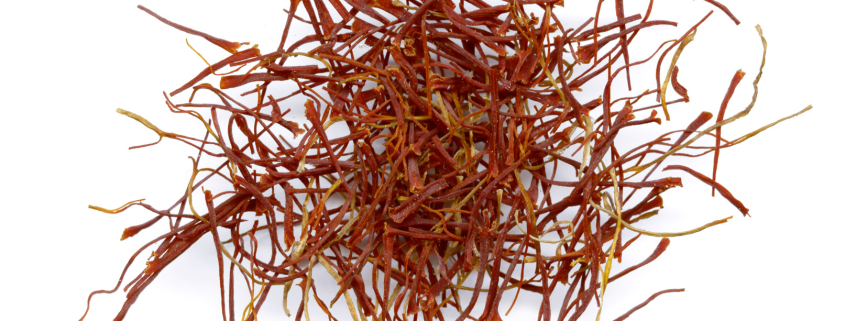
The flower follows the classic structure of the iris family: six petals, and hidden beneath them the three bright red, thread-like stigmas. These sit at the end of the style and are part of the female reproductive organ. Botanically, their role is to receive pollen. For us humans, however, these carpels serve a different purpose: they are used as a spice.

Cultivation and Harvest

Each flower yields exactly three stigmas. To produce one kilogram of saffron, around 150,000 to 200,000 flowers must be picked — each one by hand. Even experienced harvesters manage only about 60–80 grams per day. It is therefore no surprise that saffron can reach prices of up to €30,000 per kilogram — a spice sometimes compared to gold. Cultivation is concentrated in regions with dry summers and mild winters, such as Iran, India, and the Mediterranean. However, there are also smaller cultivation areas with a long tradition in Austria and Germany.

A Global Clone

The saffron crocus is triploid and sterile. This means it does not produce viable seeds and can only reproduce vegetatively, via daughter corms. Corms? Indeed. Although crocuses are often considered bulb plants, their underground storage organs are actually corms.

Research: The Origin of the Saffron Crocus

For a long time, the exact origin of this plant remained unclear. It was not until 2019 that biologists at the Technical University of Dresden solved this botanical puzzle.
Their research showed that the saffron crocus (Crocus sativus) originated from the wild species Crocus cartwrightianus. More precisely, it arose through the merging of the genomes of two slightly different individuals—so-called cytotypes—within this species. This also explains why the saffron crocus is triploid
and sterile.
The results were published in the journal New Phytologist (Schmidt et al., [2019](https://doi.org/10.1111/nph.15715)).
An earlier study also concluded that the origin of saffron was most likely a unique event. This is supported by the fact that, worldwide today, there is virtually no genetic and only very little phenotypic diversity within the species (Fluch et al., [2010](https://ishs.org/ishs-article/850_4/)).

In the Kitchen

As a spice, saffron reveals its most well-known effect. Just a few threads are enough to give dishes such as risotto, paella, chimichurri de azafrán, simple rice, as well as desserts or coffee, an intense golden-yellow color and a distinctive aroma. The threads can be used as a powder or soaked in warm water; this infusion is then added to the dish after cooking to preserve the delicate essential oils as much as possible.