In autumn, when many plants are already retreating, the saffron crocus (Crocus sativus) opens its delicate violet flowers. Unassuming at first glance — yet they contain one of the most valuable products in the plant world.
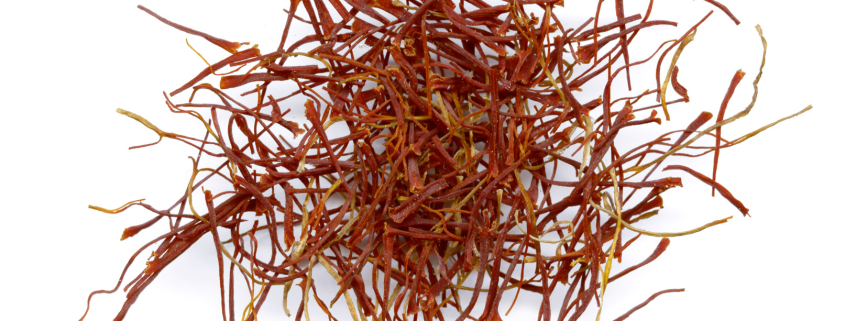
The flower follows the classic structure of the iris family: six petals, and hidden beneath them the three bright red, thread-like stigmas. These sit at the end of the style and are part of the female reproductive organ. Botanically, their role is to receive pollen. For us humans, however, these carpels serve a different purpose: they are used as a spice.
Cultivation and Harvest
Each flower yields exactly three stigmas. To produce one kilogram of saffron, around 150,000 to 200,000 flowers must be picked — each one by hand. Even experienced harvesters manage only about 60–80 grams per day. It is therefore no surprise that saffron can reach prices of up to €30,000 per kilogram — a spice sometimes compared to gold. Cultivation is concentrated in regions with dry summers and mild winters, such as Iran, India, and the Mediterranean. However, there are also smaller cultivation areas with a long tradition in Austria and Germany.
A Global Clone
The saffron crocus is triploid and sterile. This means it does not produce viable seeds and can only reproduce vegetatively, via daughter corms. Corms? Indeed. Although crocuses are often considered bulb plants, their underground storage organs are actually corms.
Research: The Origin of the Saffron Crocus
For a long time, the exact origin of this plant remained unclear. It was not until 2019 that biologists at the Technical University of Dresden solved this botanical puzzle. Their research showed that the saffron crocus (Crocus sativus) originated from the wild species Crocus cartwrightianus. More precisely, it arose through the merging of the genomes of two slightly different individuals—so-called cytotypes—within this species. This also explains why the saffron crocus is triploid and sterile.
An earlier study also concluded that the origin of saffron was most likely a unique event. This is supported by the fact that, worldwide today, there is virtually no genetic and only very little phenotypic diversity within the species (Fluch et al., [2010](https://ishs.org/ishs-article/850_4/)).
In the Kitchen
As a spice, saffron reveals its most well-known effect. Just a few threads are enough to give dishes such as risotto, paella, chimichurri de azafrán, simple rice, as well as desserts or coffee, an intense golden-yellow color and a distinctive aroma. The threads can be used as a powder or soaked in warm water; this infusion is then added to the dish after cooking to preserve the delicate essential oils as much as possible.
Flower of the Year
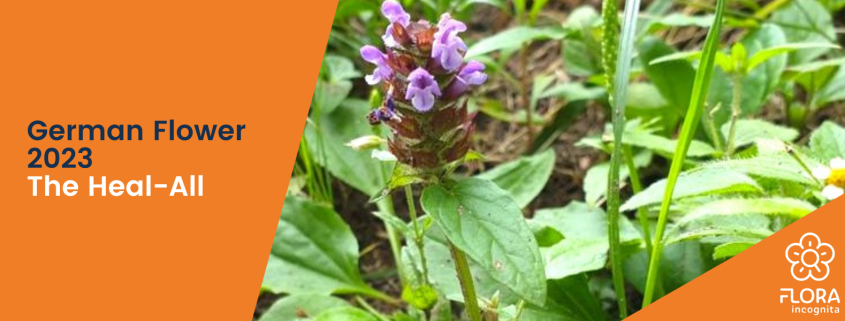
The Loki Schmidt Foundation has chosen the Small Self-Heal (Prunella vulgaris) as the Flower of the Year 2023 to draw attention to the gradual loss of numerous plant and animal species. The Small Self-Heal grows between 5 and 25 cm tall and delights observers with its small, violet flowers. Despite its delicate appearance, it thrives in frequently mowed lawns and tolerates grazing and trampling by livestock. Despite its robustness, this once common wildflower shares the fate of many other species found in meadows, pastures, and roadsides: its populations are steadily declining.
Allowing More Wilderness
The gradual loss of species is particularly evident in the case of the once common Small Self-Heal. It can thrive in many places, as long as they are not too nutrient-rich. When meadows, pastures, and paths are fertilized or surrounding landscapes are over-fertilized, it significantly impacts the composition of plant communities: a few fast-growing plant species that grow tall and dense tend to overgrow the diverse, formerly lean habitats. Currently, the Small Self-Heal is present in all federal states and is not at risk everywhere. However, in some regions of Germany, a decline in populations is noticeable, such as in Mecklenburg-Western Pomerania, Brandenburg, Hesse, Baden-Württemberg, and Bavaria.
A New Badge for You!
If you find and identify a Small Self-Heal, you will be rewarded with a new badge for your profile: the Flower of the Year 2023.
This article was featured in the Flora-Incognita app as a story in the summer of 2023. The app provides intriguing information about plants, ecology, species identification, as well as tips and tricks for plant identification. Why not take a look?
https://floraincognita.com/wp-content/uploads/2023/11/2-6.png6001600Anke Bebberhttps://floraincognita.de/wp-content/uploads/sites/4/2022/11/flora-incognita_logo_horizontal_RGB-e1669665654345.pngAnke Bebber2023-07-25 09:37:062023-11-08 09:37:16German Flower of the Year 2023: The Small Self-Heal
Our project „Flora Incognita“ for many ( and more ) people represents the almost automatic species identification of wild plants. We are grateful for the positive feedback, but of course there are always some uncertainties. For example, the areas of use of the two apps: Flora Incognita and Flora Capture
Flora Incognita – Automatically identify species
With Flora Incognita, you can automatically identify a plant in just a few moments. Depending on the type and quality of your observation, the app needs 1-3 images. You can confirm that the species is indeed identified or select another one from a list of suggestions. An internet connection is required for a determination: Either via mobile data on the go or later at home, where you can also select your photos from the gallery.
Publication:
Mäder, P., Boho, D., Rzanny, M., Seeland, M., Wittich, H. C., Deggelmann, A., & Wäldchen, J. (2021). The flora incognita app–interactive plant species identification. Methods in Ecology and Evolution. https://doi.org/10.1111/2041-210X.13611
Flora Capture – Document plants and contribute to the project
The aim of this app is to collect plant images from given perspectives. These provide, among other things, the data basis of the identification function of the Flora Incognita App. More so: it offers you the opportunity to collect plants without extracting them from nature.
Its distinctive feature is that a capture observation is taken from one and the same individual. This creates a true understanding of the variety in size, shape and color of plant parts in different degrees of flowering and maturity. This data ensures that Flora Incognita can reliably identify even difficult species.
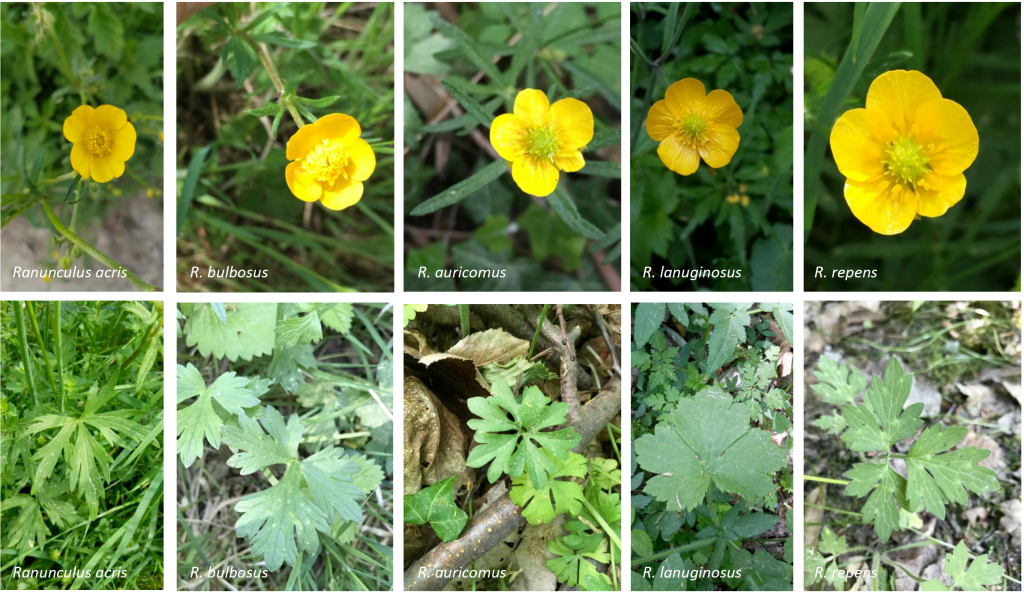
The combination of flowers and leaf images in our database enables a species-specific identification of plants even when an identification should not be possible. Here you see different types of buttercup. An identification solemnly based on the flower would hardly be possible:
So the next time you are happy that in many cases even plants without flowers are recognized correctly, this is mainly possible due to the Flora Capture observations that we have already collected.
Maybe you could make an active contribution to our project from time to time? Each Flora Capture observation is evaluated and, if possible, identified by a team of experts. This manual process may be fast if the key features are clearly visible and the species is one of the current species list (~4800 species). If not, it will take a little longer and sometimes be impossible: For species hybrids, ornamental plants or photographs taken far away from the Central European flora. Flora Capture images can be taken without an internet connection and then uploaded to our server via WLAN at home.
Publication:
Boho, D., Rzanny, M., Wäldchen, J., Nitsche, F., Deggelmann, A., Wittich, H. C., … & Mäder, P. (2020). Flora Capture: a citizen science application for collecting structured plant observations. BMC bioinformatics, 21(1), 1-11. https://doi.org/10.1186/s12859-020-03920-9
https://floraincognita.com/wp-content/uploads/2019/06/apple-6033557-01-2-e1623683392353.png400638floraincognitahttps://floraincognita.de/wp-content/uploads/sites/4/2022/11/flora-incognita_logo_horizontal_RGB-e1669665654345.pngfloraincognita2019-06-14 15:51:002021-06-15 08:41:01Flora Incognita vs. Flora Capture
Die Flora Incognita-Website verwendet Cookies, die für den technischen Betrieb notwendig sind. Darüber hinaus werden Cookies für komfortablere Website-Einstellungen verwendet. Du kannst frei entscheiden, welche dieser Cookies Du zulassen möchtest. Eine erteilte Einwilligung kann jederzeit widerrufen werden. Weitere Informationen sind in unserer Datenschutzrichtlinie zu finden.