
Flora Incognita | EN
  • Apps
    • The Flora Incognita App
    • The Flora Capture App
  • Blog
  • Publications
  • Citizen Science
  • Projects
    • Flora Incognita
    • Flora Incognita++
    • FloraFlux
    • Cooperations
  • Media
    • Downloads
  • FAQ
  • DE
  • Click to open the search input field Click to open the search input field Search
  • Menu Menu
Blog - Latest News
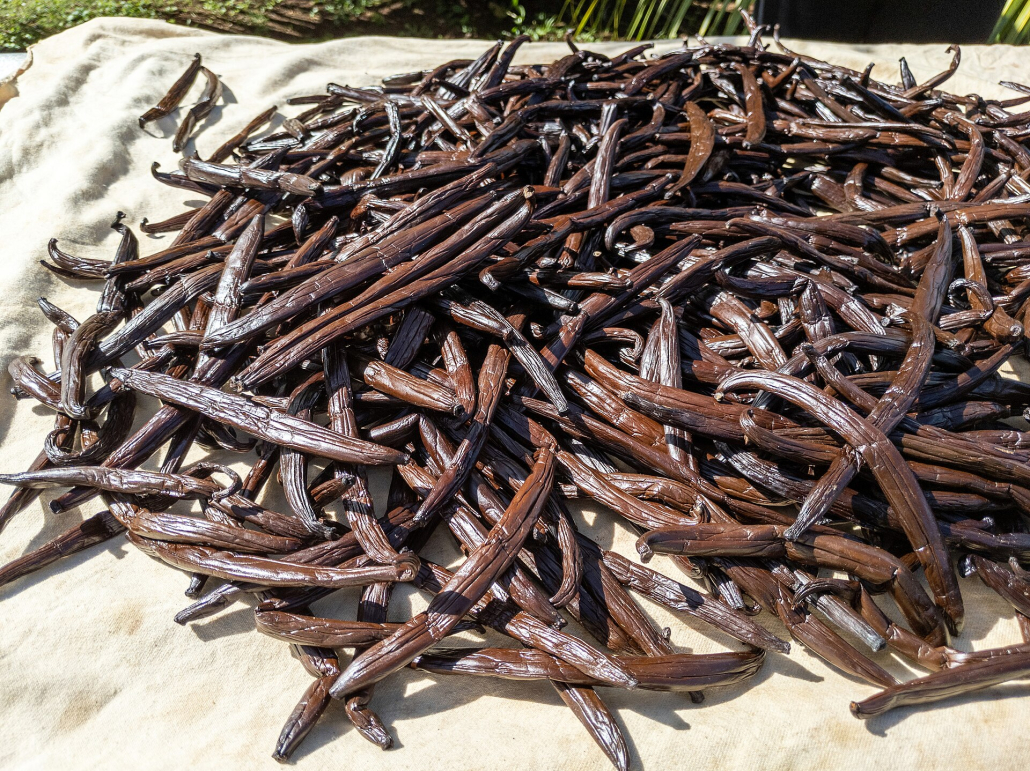
Vanilla pods. Matthew Dillon, CC BY 2.0 via Wikimedia Commons

Spices: Vanilla

31. August 2026/in Plant knowledge/by agrimm

Vanilla

An Orchid Among the Spices
Most people would associate orchids with tropical forests rather than spice racks. Yet vanilla belongs exactly to this plant family, more specifically to the genus Vanilla. Like all orchids, it produces a capsule containing countless tiny seeds after successful pollination. In vanilla, however, this capsule develops into a remarkably long fruit that acquires its characteristic aroma through a complex post-harvest curing process.

A Climbing Plant of the Tropical Forest
The vanilla plant is an evergreen climbing orchid. It produces aerial roots that serve both for anchorage and water uptake. Its natural range lies in the warm, humid lowland forests of Mesoamerica, particularly in what is now southeastern Mexico and parts of Central America. There it grows in partially shaded forest habitats with high humidity and relatively stable temperatures.
“But doesn’t vanilla come from Madagascar?” → No. Madagascar is simply the major center of its commercial cultivation.

A Flower with Specialized Pollination
Vanilla flowers remain open for only a few hours, or at most a single day. In their native range, they are primarily pollinated by stingless bees (Meliponini), which are able to navigate the flower’s specialized structure. Outside this ecological system, the necessary pollinators are absent, making hand pollination essential for commercial production.

The “Pod” That Is Actually a Capsule
Botanically, the vanilla fruit is a capsule. Following successful pollination, it develops over approximately 6–9 months. The fruit is harvested while still unripe, as the full aroma develops only during the post-harvest curing process. The seeds are embedded in a sticky matrix.

Aroma Formation from Precursors
Fresh vanilla contains very little free aroma. Instead, it is rich in precursor compounds such as glucovanillin, which are enzymatically converted after harvest into vanillin and numerous other aromatic substances. Different vanilla species also vary considerably in their chemical composition. Vanilla tahitensis is characterized by more floral and anise-like notes and a lower vanillin concentration, whereas Vanilla pompona possesses a heavier, more balsamic aroma profile. These chemical differences determine their respective uses in gastronomy and perfumery.

From Fruit to Spice
The curing process consists of several distinct stages: killing the fruit tissue through heat treatment, an enzymatic “sweating” phase, controlled drying, and subsequent maturation. These steps regulate oxygen availability, moisture, and temperature in a way that promotes the efficient conversion of aroma precursors into the characteristic flavor compounds of vanilla.

Is It Really Vanilla?
Vanilla is among the most labor-intensive cultivated crops in the world. Each flower must be pollinated individually, and each fruit harvested by hand. Limited natural pollination and the demanding curing process contribute to substantial price fluctuations. As a result, a large proportion of vanilla flavoring used worldwide is produced synthetically.
Share this entry
  • Share on Facebook
  • Share on X
  • Share on WhatsApp
  • Share on Pinterest
  • Share on LinkedIn
  • Share on Tumblr
  • Share on Vk
  • Share on Reddit
  • Share by Mail
https://floraincognita.com/wp-content/uploads/2026/08/Vanilleschoten.jpg 1438 1920 agrimm https://floraincognita.de/wp-content/uploads/sites/4/2022/11/flora-incognita_logo_horizontal_RGB-e1669665654345.png agrimm2026-08-31 13:48:532026-09-07 13:26:17Spices: Vanilla
X Logo X Logo Followon X

Latest news

Categories

  • Cooperation
  • Flora Incognita
  • Flora Incognita ++
  • Flora Incognita App
  • General
  • Plant knowledge
  • PollenNet
  • Project
  • Science

Archives

  • September 2026
  • August 2026
  • April 2026
  • March 2026
  • January 2026
  • December 2025
  • October 2025
  • September 2025
  • August 2025
  • October 2024
  • August 2024
  • July 2024
  • June 2024
  • May 2024
  • March 2024
  • January 2024
  • October 2023
  • September 2023
  • August 2023
  • July 2023
  • June 2023
  • April 2023
  • March 2023
  • February 2023
  • January 2023
  • December 2022
  • October 2022
  • August 2022
  • May 2022
  • March 2022
  • January 2022
  • November 2021
  • October 2021
  • July 2021
  • June 2021
  • November 2020
  • June 2020
  • April 2020
  • August 2019
  • June 2019

Social media

Mastodon

Facebook

Instagram

YouTube

Project leader

Prof. Dr. Patrick Mäder 

Technische Universität Ilmenau

Dr. Jana Wäldchen 

Max Planck Institute  for Biogeochemistry

Contact

Legal Notice

support@floraincognita.com

Latest News

  • Spices: Black Pepper11. September 2026 - 16:57
  • Spices: Nutmeg11. September 2026 - 16:21
  • Public Domain
    Spices: Saffron6. September 2026 - 18:48

Project management

Prof. Dr. Patrick Mäder 

Technische Universität Ilmenau

Dr. Jana Wäldchen 

Max-Planck-Institut für Biogeochemie

Contact

support@floraincognita.com

Impressum

© Copyright - Flora Incognita
  • Link to X
  • Link to Facebook
  • Link to Instagram
  • Link to Youtube
Scroll to top Scroll to top Scroll to top

Diese Webseite nutzt Cookies. Standardmäßig verwenden wir nur technisch notwendige Cookies.

Technisch notwendige Cookies erlaubenAlle Cookies erlaubenEinstellungen

Cookie and Privacy Settings


Wie wir Cookies verwenden

Die Flora Incognita-Website verwendet Cookies, die für den technischen Betrieb notwendig sind. Darüber hinaus werden Cookies für komfortablere Website-Einstellungen verwendet. Du kannst frei entscheiden, welche dieser Cookies Du zulassen möchtest. Eine erteilte Einwilligung kann jederzeit widerrufen werden. Weitere Informationen sind in unserer Datenschutzrichtlinie zu finden.

Google Webfont Einstellungen:

Vimeo und YouTube Einstellungen:

2
3
4
5
Einstellungen akzeptieren