
Series: Spices
Capers
Pickled flower buds
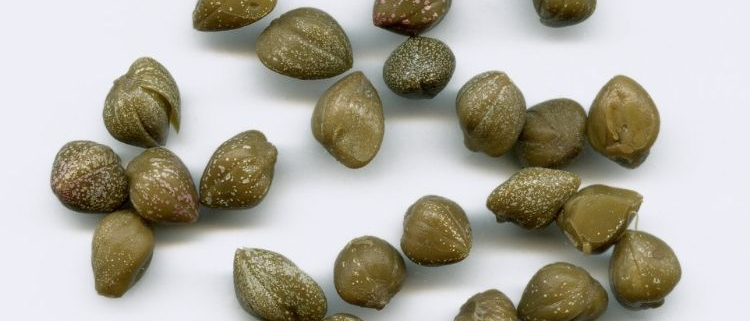
Those small green spheres—whose tangy aroma delights some and repels others—are the unripe flower buds of the caper bush, Capparis spinosa. They are harvested by hand, then left to wilt slightly before being preserved in brine and vinegar. During this process, mustard oil glycosides and capric acid develop, giving capers their characteristic pungent flavor.
Caper bush
Capparis spinosa is native to the Mediterranean region but is now also found in areas such as the Arabian Peninsula, the Caucasus, India, Nepal, the Philippines, and the Canary Islands. Commercial cultivation is concentrated in southern France and the Aeolian Islands. The plant is a small, thorny shrub whose branches often trail along the ground. If the buds are not harvested, they develop into striking, fragrant flowers with large white petals and up to 100 violet stamens. These, in turn, produce berry-like fruits known as caper berries, which are also used in cooking.
On the plate
Pickled capers are available in various sizes—the smaller, the higher their quality. When used in warm dishes, they are typically added only toward the end of cooking. Capers preserved by salting—common in Spanish and Italian cuisine—are usually rinsed beforehand. Caper berries, likewise pickled in vinegar or oil, are popular as tapas in Spain, while in Greece and Cyprus the leaves of the plant, preserved in salt or vinegar, are considered a delicacy.
A long history
Archaeological evidence shows that capers have been consumed for several millennia. At Tell es-Sa’idiyeh in present-day Jordan, charred caper buds were found in a bowl. They date to the Early Bronze Age (ca. 2000 BCE).
A conflagration preserved the room in which they were stored. It was likely a kind of storage chamber. Experimental comparisons with fresh and dried fruits (grapes, figs, olives, pomegranates, cereal grains) show that the finds were not burned fresh. They had already been dried and thus preserved beforehand. The capers may also have been pickled in vinegar.
(Source: Caroline R. Cartwright: Grapes or raisins? An early Bronze Age larder under the microscope. In: Antiquity. 296, 2003, 345–348.)


