Flowers: Variety of Inflorescences
Flower diversity
The colourful flowers of the different plant species always fascinate us. Some species, such as Anemone nemorosa, form inconspicuous single flowers. Others, on the other hand, catch our eye especially because of the multitude of flowers which form an inflorescence.
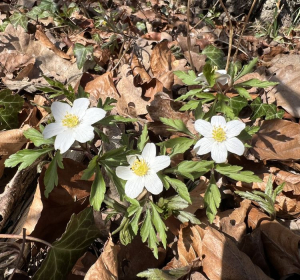
Anemone nemorosa. Photo by Anke Bebber.
Single flowers
The general structure of a flower can be described as follows: The respective flowers are located at the upper ends of the flower stalk, which is thickened and forms the flower base. Up to four types of modified leaves can then attach to the base of the flower: Sepals, petals, stamens and carpels. While the sepals and petals are sterile, the stamens and carpels are the fertile part of the floral organ. In many plant species, the growth of the main shoot is completed with the formation of a single flower.
Inflorescence
More often, however, a large number of flowers are produced by branching of the shoot axis, resulting in the formation of an inflorescence. In these inflorescences, the leaves are usually not formed as deciduous leaves, but as smaller bracts or bracteoles. Furthermore, the diverse types of inflorescences can also be divided differently, such as into simple and compound inflorescences.
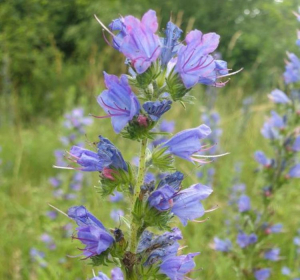
Echium vulgare. Photo by Martina Hartel.
Raceme
A characteristic of simple inflorescences is the formation of an unbranched inflorescence axis. The raceme is a form of simple inflorescence. It has only single, stalked flowers on the main axis. Examples of this can be found in Epilobium angustifolium, Digitalis purpurea or Agrimonia eupatoria, among others.
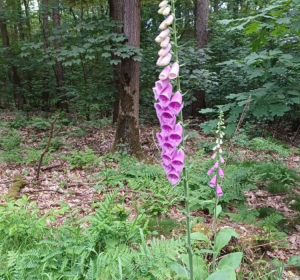
Digitalis purpurea. Photo by Martina Hartel.
Spike
The spike is also a form of simple inflorescence. Here the unstalked individual flowers stand directly on the main axis. Typical example species are the so-called spike grasses, such as English ryegrass (Lolium perenne) or wheat (Triticum aestivum). Among herbs, we find spikes, for example, in the plantain species, such as Plantago lanecolata, or – with a somewhat more colourful inflorescence – in Gladiolus palustris.
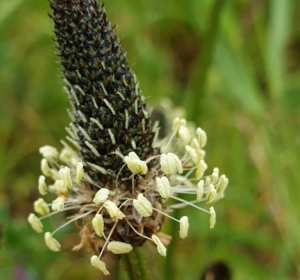
Plantago lanecolata. Photo by Martina Hartel.
Catkin
Catkins are the often hanging, male inflorescences of some trees or shrubs. These consist of small inconspicuous individual flowers which grow as racemes or spikes. Willow catkins are formed on all willow species, with the early-sprouting, fluffy catkins of Salix caprea being particularly well known. But many other well-known trees also form catkins, such as Quercus robur, Corylus avellana or Betula pendula.
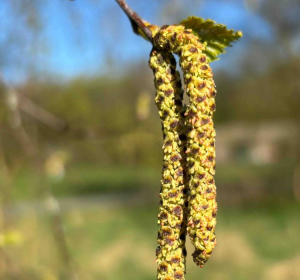
Betula pendula via Flora Capture.
Umbel
An umbel is an inflorescence in which the stalked flowers all start from one point. The main axis is thus strongly shortened. Often the inflorescence then looks like an umbrella. Well-known plants with umbels as inflorescence are for example Heracleum sphondylium, Anthriscus sylvestris, but also Primula veris.
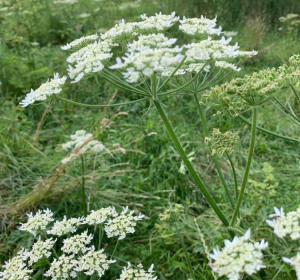
Heracleum sphondylium. Photo by Ralf Littger.
Panicle
In compound inflorescences, a branched inflorescence axis is formed. The lateral axes of the panicle are monopodially branched. This means that there is a continuous main axis from which the inflorescences branch off. Typical examples can be found in meadow grasses, such as Poa pratensis or Dactylis glomerata.
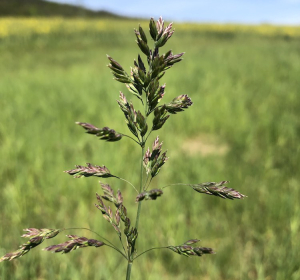
Poa pratensis. Photo by Michael Rzanny.